
ACUPOINT RENO | INDEPENDENT LOCAL GUIDE
Moxibustion in Reno: Benefits, Safety, and Visits
Moxibustion uses warmth from burning dried mugwort near acupuncture points. Studies have compared it with other care for knee pain and nausea. This guide explains the methods, research, and precautions that protect your skin and breathing.
Last updated: November 2026
Key Takeaways
- Burning dried mugwort warms acupuncture points, sometimes without needles.
- Some study groups had better knee pain or nausea scores than their comparisons.
- Hot ash, burns, smoke, and fire are central safety risks.
- Pregnancy, children, and reduced skin sensation need extra care.
- Stop for stinging, blisters, breathing trouble, or chest tightness.
How does moxibustion work?
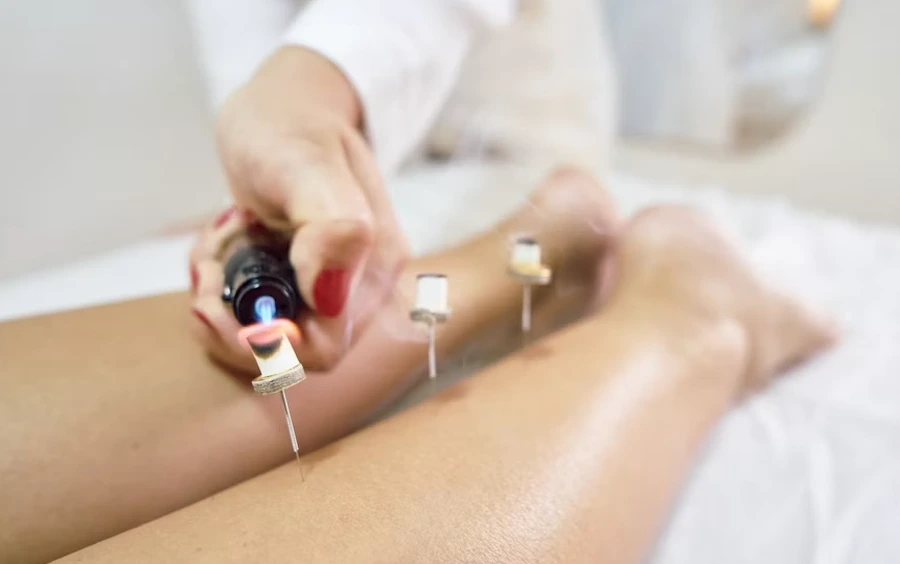
This method warms acupuncture points with heat from burning dried mugwort, called moxa. A trained acupuncturist may hold a glowing stick above your skin or use a protected needle method. Cleveland Clinic describes the main methods.
Heat from the stick warms the skin and tissue beneath it. It may increase nearby blood flow and stimulate heat-sensitive nerves, which researchers think could affect how the body handles pain signals. Traditional Chinese medicine describes this as improving the flow of qi, but the exact mechanism is not established, as a 2013 review explains.
Merck Manual describes the method and burn risks. Changes in blood flow or nerve activity alone do not prove pain relief. Ask how the heat will be controlled, and remember you may decline treatment.
What are the benefits of moxibustion?
Research has found better group results for some specific concerns:
- Knee pain: A 2025 review of 43 studies with 4,008 people found lower pain and better knee function in comparisons with other care.
- Nausea during chemotherapy: A 2024 trial of 60 patients reported less nausea and vomiting on some days when heat treatment was added to prescribed anti-nausea medicine.
- Breech position: A 2023 review of 13 trials found fewer babies still in a breech position at birth when moxa was added to usual pregnancy care.
- Arthritic knees: A 2014 trial of 212 adults found better knee pain and activity scores than with usual care alone.
For knee symptoms, our knee pain guide explains related care. These results do not mean that burning heat is suitable for every person or condition.
What do moxa studies show for different conditions?
The evidence is mixed. Some findings were small or uncertain, and study methods differed. Pretend treatment means a comparison that looks similar without the intended heating effect.
- 2025, knee arthritis: An analysis of 43 studies found better average pain and movement scores [4]. Comparison groups and warming methods varied, so the result does not apply to every type.
- 2024, chemotherapy-related nausea: In a small trial, adding heat-sensitive moxa to anti-nausea medicine improved scores on several days [5]. It was an added treatment, not a substitute for prescribed medicine.
- 2023, breech babies: A review found fewer babies remaining breech at birth [6], but little or no change in caesarean births. Side effects were poorly reported. This approach must stay under maternity-clinician supervision and must not be tried alone.
- 2019, knee treatment methods: In 138 adults, knee pain and function did not clearly differ between smoke-free and conventional methods. There was no untreated group.
- 2017, menstrual cramps: A trial of 152 people found no clear pain difference from medicine after three months. Later follow-up favored warming, but participants knew their treatment.
- 2014, knee arthritis: A trial found better pain and function scores than usual care [7], mainly in milder cases. It also reported burns and did not show cartilage regrowth.
Results for one condition cannot establish benefits for another. The findings do not support detoxification or cure claims.
How do different moxa methods compare?
Heat may come from a stick, a needle handle, or a holder separated from the skin. All forms need careful heat control.
| Method | How it works | Main check |
|---|---|---|
| Held stick | A glowing stick stays above the skin | Control distance, ash, and heat |
| Warm needle | A small moxa cone burns on a needle handle | Shield the skin from falling ash |
| Indirect method | A holder or barrier separates the burning herb from skin | Monitor heat under the barrier |
| Smoke-free product | Prepared material makes less visible smoke | Still check heat and product warnings |
Direct burning on skin can cause blisters and scars. Ask what shields your skin, especially with needles.
What happens during a visit?
The acupuncturist should ask about your symptoms, medicines, pregnancy, and health history. They should check the treatment area and explain the method before seeking consent.
You may sit or lie down while the practitioner warms a point. Warm-needle methods involve inserting thin needles first. The practitioner should monitor your skin, control the heat, and protect your hair and clothes from falling ash.
Ask the practitioner to move the heat away before you change position. You may stop at any time, and the moxa must be fully extinguished afterward. Our first-visit guide explains preparation and consent.
What does the heat feel like?
You may feel growing warmth and smell the burning herb. It should never sting or feel sharply painful. Tell the acupuncturist immediately if it becomes too hot.
Stronger heat is not proof of a better result. Afterward, check for pain, unusual redness, or a blister, and seek burn-care advice if needed.
How many visits did trials use?
Two trials used 7 to 12 visits over 1 to 4 weeks. These are research schedules, not a standard course for everyone.
| Named trial | Schedule | Compared care |
|---|---|---|
| 2024 nausea trial | Seven daily sessions | Prescribed medicine with or without heat treatment [5] |
| 2019 knee trial | Twelve sessions in four weeks | Conventional versus smoke-free warming [8] |
Ask how progress and skin comfort will be checked. Neither trial schedule tells you how many sessions you need.
When should you seek urgent medical help?
Stop immediately and seek help for these warning signs:
- Severe burn: Large, deep, very painful, or numb burns, or burns on the face or genital area.
- Open or infected blister: Pus, spreading redness, warmth, swelling, or fever.
- Breathing trouble: Wheezing, shortness of breath, or difficulty getting air after smoke exposure.
- Chest tightness: New or severe pressure, especially with breathing difficulty.
- Fire: Burning clothes or nearby items. Move to safety and call emergency services.
For a burn, NHS advises cooling the skin under cool running water for 20 minutes. Do not use ice, butter, or creams, or burst blisters. Cover cooled skin loosely with a clean dressing. Get urgent care for serious burns and emergency help for severe breathing trouble or a fire.
Who should take extra care?
Heat, flames, and smoke can create risks. Published practice guidance describes precautions and areas to avoid.
- Smoke and breathing: Asthma, COPD, and other lung problems make smoke exposure concerning. CDC explains the risks from smoke particles. Ask about ventilation and stop if breathing becomes uncomfortable.
- Burns and allergies: Contact with ash or mugwort can injure skin or cause reactions. A review of adverse events describes burns, blisters, allergies, and infections.
- Reduced sensation: Diabetes, neuropathy, or numb skin can make unsafe heat hard to detect. Avoid treatment over areas where you cannot feel temperature reliably.
- Pregnancy: Ask your maternity clinician before any warming treatment. Do not attempt this technique alone.
- Children and older adults: Children may struggle to report heat, and older adults may have fragile skin. Keep children away from flames and ash.
- Illness and sensitive areas: Avoid fever-related illness, active infection, broken or inflamed skin, and fresh burns. Do not apply burning material to the face or genital area. Mention medicines that affect healing.
What should you check before using a home kit?
Home kits contain sticks, holders, or point charts but cannot assess your health. Check with a qualified acupuncturist before trying one.
Before buying: Check ingredients, smoke warnings, clear instructions, and a stable, undamaged holder. Make sure you can extinguish the stick safely. Keep equipment away from children and pets.
Before lighting: Never use a kit while alone or sleepy, beside bedding or curtains, or near oxygen equipment. Never leave a lit stick unattended. Do not attempt warm-needle treatment yourself.
When to stop: Stop for burning pain, blisters, coughing, dizziness, or chest discomfort. Extinguish the material fully, and remember that equipment may remain hot. Follow burn first aid when needed. A kit cannot treat unexplained or serious symptoms.
Frequently Asked Questions
Does moxa treatment hurt?
You may feel gentle warmth, but a session should not cause burning pain. Tell the acupuncturist immediately about sharp heat, stinging, or skin pain. Ask how they will protect you from falling ash and check the temperature. You can stop the procedure whenever you feel uncomfortable. You do not need to endure pain to make the treatment work.
Can moxa help knee arthritis?
Some studies found better knee pain and function scores than comparison care [4]. The findings do not mean every form will help every knee. A burning technique also carries a risk of skin injury. Ask your healthcare professional to assess ongoing knee symptoms before choosing any additional treatment. Our knee pain guide explains the research and important warning signs.
Is it safe with asthma or COPD?
Smoke can irritate breathing if you have asthma, COPD, or another lung condition. Tell the acupuncturist about your breathing history and any reactions to smoke. A product labeled smokeless can still create exposure. Ask whether a technique without a burning herb would suit you better. Leave the treatment area and seek care if you develop wheezing or difficulty breathing.
Is moxa used for breech babies?
A 2023 review [6] found fewer breech babies at birth when treatment was added to usual maternity care. However, caesarean birth rates changed little or not at all, and side effects were poorly reported. Do not use burning moxa at home to turn a baby. Ask your maternity clinician about the baby’s position and medically supervised options. Follow their advice on whether any added treatment is appropriate.
Is a home moxa kit safe?
A kit cannot replace the safety checks performed by a trained professional. Hot ash can burn skin, and nearby materials may catch fire. Ask a qualified acupuncturist whether your health history makes this approach unsuitable. Keep supplies away from children and do not apply burning material directly to skin. If you develop a blister or feel unwell, stop and seek appropriate medical advice.
Does insurance cover this treatment in Reno?
Coverage depends on the plan, diagnosis, and how a practitioner bills for the service. A plan that covers acupuncture may not cover this added warming method or home supplies. Our Reno acupuncture insurance guide explains how to ask about covered services, referrals, and out-of-pocket costs. Contact your insurer before paying and request written confirmation. Keep the representative’s name and any reference number.
Considering moxibustion in Reno
This approach uses burning mugwort to warm acupuncture points, sometimes with needles. Ask how the acupuncturist controls heat and which research findings relate to your symptoms.
Before a visit in Reno, discuss symptoms with a clinician and review the acupuncture safety guide. You can choose a different approach if this does not feel right for you.
References
- Cleveland Clinic. Moxibustion: What Is It and Does It Work? Accessed November 2026.
- Deng H, Shen X. The Mechanism of Moxibustion: Ancient Theory and Modern Research. Evid Based Complement Alternat Med. 2013;2013:379291. PMID: 24159344.
- Merck Manual Professional Edition. Moxibustion. Accessed November 2026.
- Chen S, Liu W, Liang C, et al. Efficacy and safety of moxibustion for knee osteoarthritis: A systematic review and meta-analysis. Complement Ther Clin Pract. 2025;59:101979. PMID: 40184698.
- Zhou M, Yang S, Chen R, et al. Heat-sensitive moxibustion combined with tropisetron hydrochloride for chemotherapy-induced nausea and vomiting: a randomized controlled trial. Zhongguo Zhen Jiu. 2024;44(5):531-536. PMID: 38764103.
- Coyle ME, Smith C, Peat B. Cephalic version by moxibustion for breech presentation. Cochrane Database Syst Rev. 2023;5:CD003928. PMID: 37158339.
- Kim TH, Kim KH, Kang JW, et al. Moxibustion treatment for knee osteoarthritis: a multi-centre, non-blinded, randomised controlled trial on the effectiveness and safety of the moxibustion treatment versus usual care in knee osteoarthritis patients. PLoS One. 2014;9(7):e101973. PMID: 25061882.
- Luo L, Liao M, Peng JX, et al. Comparison of the Efficacy between Conventional Moxibustion and Smoke-Free Moxibustion on Knee Osteoarthritis: A Randomized Controlled Trial. Evid Based Complement Alternat Med. 2019;2019:1291947. PMID: 31001350.
- Yang M, Chen X, Bo L, et al. Moxibustion for pain relief in patients with primary dysmenorrhea: A randomized controlled trial. PLoS One. 2017;12(2):e0170952. PMID: 28170396.
- National Health Service. Burns and scalds. Accessed November 2026.
- The Acupuncture Society. Code of Safe Practice: Contra-Indications and Guidance for Safe Moxibustion. Accessed November 2026.
- Centers for Disease Control and Prevention. Air Pollutants. Accessed November 2026.
- Park JE, Lee SS, Lee MS, Choi SM, Ernst E. Adverse events of moxibustion: a systematic review. Complement Ther Med. 2010;18(5):215-223. PMID: 21056845.
This information is provided for general educational purposes and is not a substitute for professional medical advice, diagnosis, or treatment. Always consult a qualified healthcare provider regarding your specific condition before starting or changing any treatment.